Culture
Kathakali in Kochi: what you are watching, and where
Red faces, green faces and a drum that starts before the curtain: how Kathakali works, what the gestures carry, and how to watch an evening show critically.
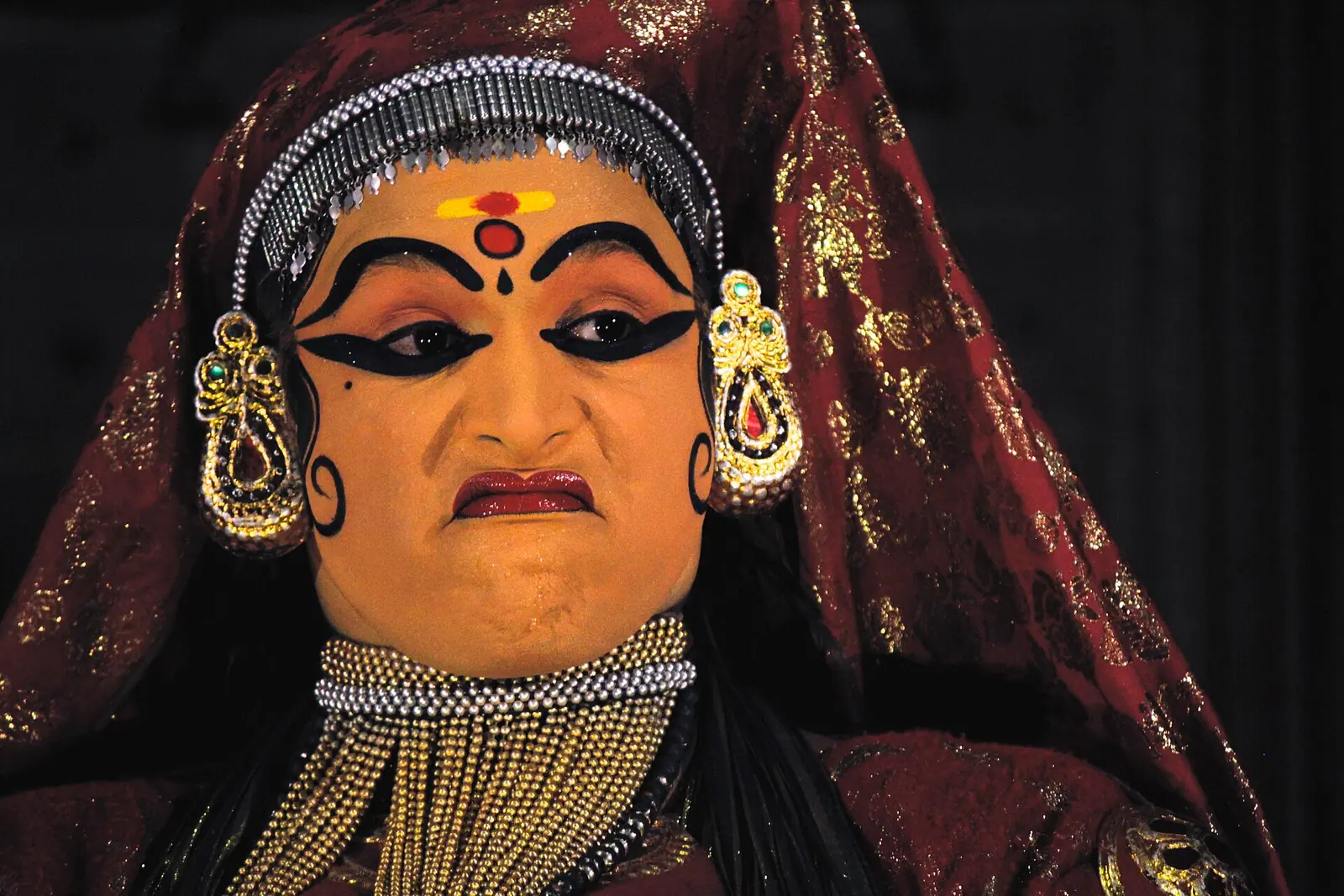
Photograph: Evan Silver / CC BY-SA 4.0, via Wikimedia Commons
A form built for a night
Kathakali took its present shape in seventeenth-century Kerala, out of older temple theatre and ritual performance. It is dance-drama in the strict sense: the actors do not speak. A singer narrates, the drummers carry the rhythm, and the performers act the story through codified gesture and expression.
A traditional performance ran all night, outdoors, on a temple ground, lit by lamps. The stories come from the Mahabharata, the Ramayana and the Puranas, and the audience already knew them, which is why the form spends its time on interpretation rather than plot.
What a visitor in Kochi will see is a shortened version, usually one or two episodes, staged indoors in the evening. That is a fair introduction and a poor substitute, and it helps to know which one you are getting.
Reading a face
The make-up is a code, not decoration. Green — pacha — marks the noble hero. A red-streaked face with a knife-like moustache, kathi, marks the arrogant villain. The bearded characters, thadi, split into red for demons, black for hunters and forest figures, and white for the monkey Hanuman.
The chutti, the raised white ridge built along the jawline from rice paste, takes hours to apply and changes the whole geometry of the face. Women and sages wear minukku, a simpler, warmer make-up without the ridge.
Once you know the code, the stage stops being a wall of colour: you can tell who is about to be humiliated before the drums do.
What the hands carry
Kathakali uses a system of hand gestures, mudras, drawn from a text called the Hastalakshanadipika. There are around two dozen basic gestures, and they combine into a vocabulary that can say 'forest', 'fear', 'remember' or 'listen' without a word.
The eyes and eyebrows carry as much as the hands. Performers train the eye muscles deliberately, following a lamp, so that an expression can travel to the back of a large ground.
You do not need to learn the vocabulary to follow a scene, but recognising three or four gestures — the mudra for 'no', for 'come', for 'water' — makes the evening considerably more interesting.
The orchestra
The sound is led by the chenda, a barrel drum played with sticks, and the maddalam, a softer drum played by hand. A metal gong, the chengila, marks the structural beats, and small cymbals, elathalam, keep the cycle.
The singers sit at the side with a lead vocalist and a supporting voice. The text they sing is the story; the actors' gestures are a simultaneous translation. When the drums take over for a stretch of pure movement, the story pauses and the character's state of mind is allowed to expand.
Listen for the moment the drums change pattern under a character's entrance. That cue is how the form tells you someone important has arrived.
Watching well
Ask before the show whether it is an excerpt and how long it runs. A ninety-minute programme that includes a make-up demonstration is a different thing from a full episode, and both are sold as 'Kathakali'.
Arrive early enough to watch the make-up being applied, if the venue allows it. That part is not a warm-up; it is half the art, and it is the only chance you will get to see the performers as craftsmen rather than gods.
If you are in Kerala during a temple festival season, try to see a village performance as well. It is longer, colder, less comfortable and much closer to what the form actually is.
The district in brief
Kochi is the commercial heart of Kerala, with a Portuguese-Dutch-British old town at Fort Kochi, a modern city across the water, and a string of islands and beaches running north. It is the most useful arrival point for a first trip.
Elsewhere in Ernakulam
Fort Kochi. Kochi's old harbour quarter: Chinese fishing nets, colonial churches, spice warehouses and a strong cafe culture.
Destination in this story
 HeritageFort KochiErnakulam
Cherai Beach. A long, lively beach on Vypin island where the Arabian Sea meets the backwaters.
Destination in this story
 BeachCherai BeachErnakulam
Thattekad Bird Sanctuary. A small, bird-rich forest sanctuary in the low hills east of Kochi, best explored with a local guide.
Destination in this story
 WildlifeThattekad Bird SanctuaryErnakulam
Practical notes
- Ask whether the show is an excerpt or a full episode before booking.
- Arrive for the make-up demonstration; it explains the performance.
- Sit where you can see the drummers as well as the stage.
- Photography rules vary by venue — ask, and never use flash.
- A short explanation of the story beforehand makes the evening.
- Do not leave at the interval; the second half usually carries the scene.
Common questions
- Do I need to understand Malayalam? No. The story is sung, but it is carried by gesture, make-up and music. A printed synopsis is enough.
- How long are the shows? Evening shows for visitors usually run one to two hours with a make-up demonstration. Traditional temple performances run much longer, often through the night.
- Is Kathakali the same as Kutiyattam? No. Kutiyattam is an older Sanskrit theatre tradition, also from Kerala, with a different technique and much slower pace.
Plan this trip
Planning a trip to Kathakali in Kochi, Ernakulam?
There is no mapped record for Kathakali in Kochi yet, so no route is drawn. The planner opens with Kathakali in Kochi named, and a person can check what is actually there.
PLAN TRIP HERE CONTACT US TO ARRANGE THIS TRIPA trip-arrangement request, not a booking. Nothing is confirmed or charged here.
Sources & notes
- Kerala Tourism — official state tourism portal · checked 2026-10-22
- Wikipedia — place and history reference · checked 2026-10-22
- Kerala Tourism — Ernakulam district · checked 2026-10-22
Last updated 29 October 2026. Prices, opening hours and transport should be confirmed with official sources before travel.
Hello Kerala Publisher
Hello Kerala's editorial desk.
Found an error or an outdated detail?
Tell us