Hill country
Tea, cardamom and rubber on the Ponmudi road
The road to Ponmudi climbs through rubber, cardamom and tea in the space of an hour. A guide to what grows at each height, and why the same hill carries three crops.
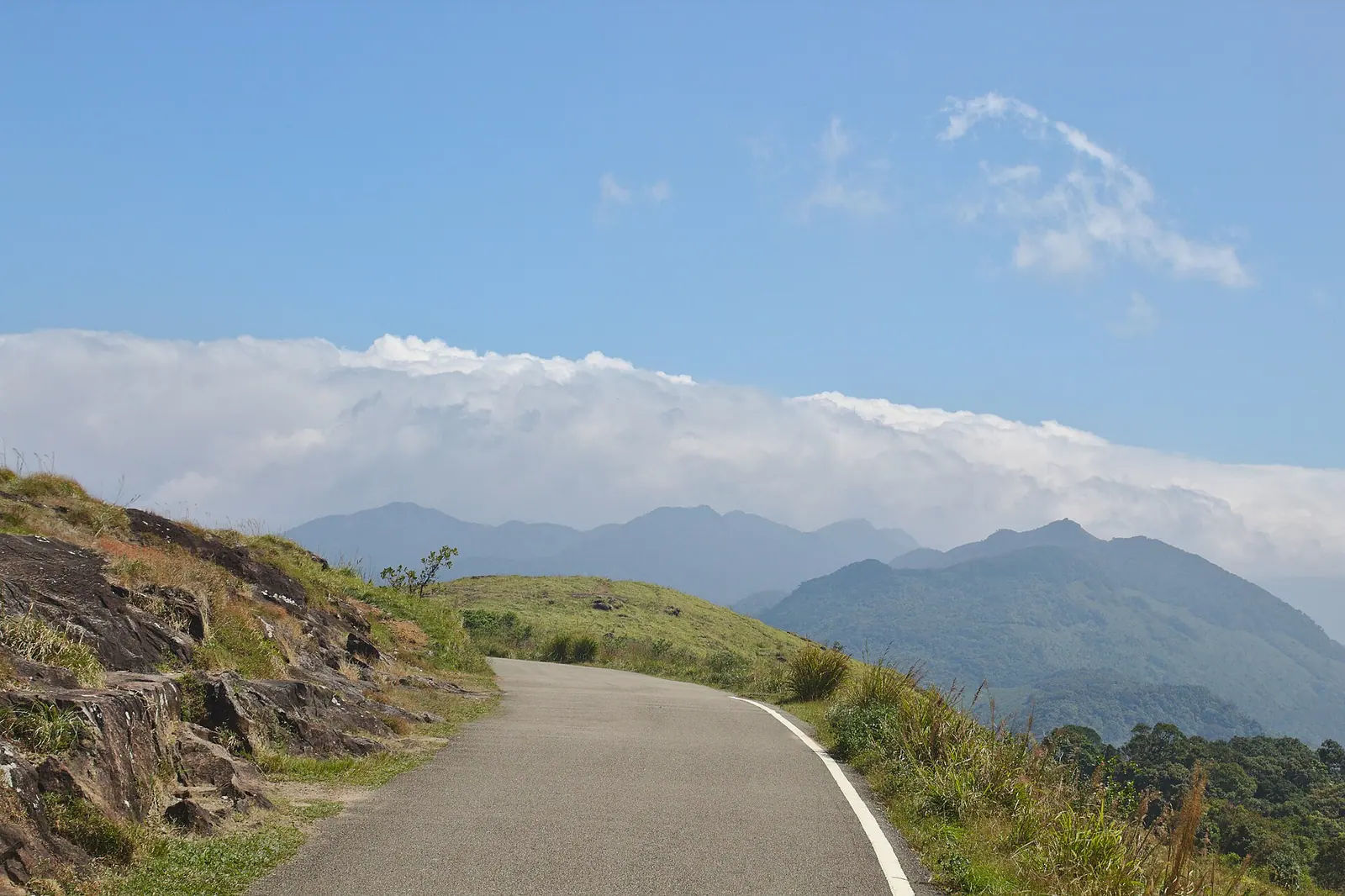
Photograph: Shishirdasika / CC BY-SA 4.0, via Wikimedia Commons
The Ponmudi road is usually described as a drive, and it is a good one: hairpins stacked on hairpins, a viewpoint at the top, and cloud that arrives without warning. But the more interesting thing about the climb is what happens on the way up. In about an hour you pass through three different agricultural worlds, each one dictated by altitude, rainfall and how quickly water leaves the soil.
None of it is a museum. These are working estates and smallholdings, and the road exists largely because of them.
Destination in this story
Hill stationPonmudiThiruvananthapuramClimbing through three climates
The coastal plain and the lower slopes are hot and humid, and they suit rubber, coconut, tapioca and banana. A few hundred metres higher the air cools, the rain is heavier and more continuous, and the crops change with it: pepper on shade trees, cocoa, coffee in pockets, and cardamom under forest canopy.
Near the top, where the cloud sits and the wind carries moisture straight into the leaves, tea becomes viable. Tea is not a Kerala lowland crop. It needs cool air, mist and steady rain, which is why the state's tea gardens sit in a handful of high pockets rather than across the midlands.
Rubber, the crop that reorganised the hills
Rubber arrived in Kerala at the end of the nineteenth century and spread through the midlands in the twentieth, and it changed the look of the place. A rubber estate is orderly in a way that a spice garden is not: straight ranks of trees, clean undergrowth, and a rhythm of tapping that starts before dawn and finishes while the day is still cool.
The latex runs when the bark is cut in a thin spiral and collected in a cup tied below the cut. Trees are tapped on a rotation, rested, and tapped again. It is skilled work, and the tappers who do it are usually the people who know the estate best. A plantation that looks empty at midday is not idle; the day's work happened hours earlier.
Cardamom and pepper in the shade
Cardamom grows as an understorey plant, which means it needs trees above it and moisture around its roots. The capsules are picked by hand, green, before they open, and dried slowly. Anyone who has only met cardamom as a pale pod in a spice jar will be surprised by how much of the hillside it occupies for such a small amount of finished spice.
Pepper is a vine, not a tree, and it is grown up whatever support is available: a dead tree trunk, a jackfruit, a silver oak. The two crops often share a slope, which is why a walk through the spice belt looks like disorder until someone explains which plant is climbing which.
What the estates mean for a visitor
Estate land is private land. The road is public and the viewpoints are public, but a track into the tea or a row of rubber trees is someone's workplace, and walking in uninvited is trespass rather than exploration. Where a homestay or a plantation offers a guided walk, take it; that is the version where you learn what you are looking at and the estate knows who is on its land.
The same applies to photographs. A tea plucker at work is not a prop, and a request costs nothing.
The season that suits the climb
The clearest months are from December into February, when the mist lifts for long enough to see the ridges and the road is dry. The southwest monsoon, from June, brings the heaviest rain of the year: the hills are at their greenest and the waterfalls are full, but cloud can close the view entirely and leeches are active off the paved surfaces.
Whatever the month, the top of the climb is cooler than the coast by a margin worth packing for. A jacket that seems unnecessary in the city is not unnecessary at a thousand metres in the rain.
Getting there
The nearest airport and railhead: Trivandrum International Airport (TRV), ~65 km · Thiruvananthapuram Central (TVC), ~60 km.
- By air: Trivandrum International Airport is about 65 km away, roughly 2 hours by car.
- By rail: Thiruvananthapuram Central is about 60 km away; taxis or a hired car are the practical option.
- By road: Drive via Kallar; the final stretch is narrow with sharp hairpins. Local buses run but are infrequent and slow.
Once there, A hired car with a driver is the sensible choice. Local buses connect the town but do not give you flexibility on the ghat road.
What to do while you are there
- Drive the Kallar–Ponmudi ghat road and stop at the designated viewpoints
- Walk through the tea estate near the top
- Visit Meenmutty Falls (a short, uneven walk) when conditions are safe
- Overnight for a cool morning and a quiet sunrise
Access, safety and health
Poor. Expect steps, uneven paths and no dedicated accessible facilities. The ghat road is narrow with blind bends. Use an experienced driver, avoid night driving and check for landslip warnings during the monsoon. Leeches are common on forest walks in the wet season.
Fees, hours and permits on record
No general entry fee; some viewpoints or falls may charge a small local fee.
Daylight hours. The ghat road is best avoided after dark.
Nearby, less obviously
- Golden Valley
- Neyyar Dam and wildlife sanctuary
Practical notes
- Start early; cloud often closes the view by afternoon.
- Carry a light jacket, even in a hot month — the top is much cooler than the coast.
- Stay on the road and public viewpoints; estate tracks are private land.
- Ask before photographing anyone working, and do not walk into the tea.
- If you want to understand the crops, a plantation stay or guided walk is worth the money.
Common questions
- Can you visit a tea estate on the Ponmudi road? Only with permission. Estate land is private and working; some homestays and gardens offer guided visits, which is the straightforward way in.
- Why does Ponmudi have tea when most of Kerala does not? Tea needs cool air, mist and reliable rain. Only a few high pockets in the state have all three, and the upper Ponmudi slopes are one of them.
- Is the drive safe in the monsoon? The road is paved and used daily, but heavy rain brings low cloud, slick surfaces and occasional fallen branches. Drive in daylight and ask locally about conditions after a storm.
- Can I visit Ponmudi as a day trip from Kovalam? Yes. It is a long but manageable day trip by hired car, typically eight to ten hours including stops.
- Is there good accommodation at the top? Options are limited and basic. Many travellers stay in Thiruvananthapuram or Kovalam and visit as a day trip.
Plan this trip
Planning a trip to Ponmudi, Thiruvananthapuram?
Nearby places around Ponmudi with real road distances, listed stays, and a route you build yourself.
PLAN TRIP HERE CONTACT US TO ARRANGE THIS TRIPA trip-arrangement request, not a booking. Nothing is confirmed or charged here.
The full place guidePonmudiThiruvananthapuram · how to get there, when to go, what it costsSources & notes
- Kerala Tourism — official state tourism portal · checked 2026-10-22
- Wikipedia — place and history reference · checked 2026-10-22
- Kerala Tourism — Thiruvananthapuram district · checked 2026-10-22
Last updated 30 October 2026. Prices, opening hours and transport should be confirmed with official sources before travel.
Hello Kerala Publisher
Hello Kerala's editorial desk.
Found an error or an outdated detail?
Tell us