Heritage
Kollam's cashew coast: warehouses, lighthouses and the old port
Before tourism, Kollam ran on cashew, coir and the sea. A walk through the old port streets explains the town's shape, and why the lighthouse still matters.
Kollam is one of the oldest ports on the Malabar Coast, and for long stretches of its history the sea was more important than the beach. Arab, Chinese, Portuguese, Dutch and British traders all passed through. The town was known for cashew and coir, and the warehouses and processing sheds that grew around those trades still shape the streets near the waterfront.
The result is a town that rewards walking without a fixed route. Start near the port, head north through the old commercial streets, and finish at Tangasseri, where the lighthouse stands above the coconut palms. It is not a curated heritage quarter, and that is part of its character.
Cashew and coir
Cashew processing was once one of Kollam's largest employers, with rows of workers shelling, peeling and grading nuts by hand. The industry has contracted sharply, but the warehouses remain, and the smell of cashew shell oil still hangs around some yards. Coir, made from coconut husk, was the other pillar: rope, mats, brushes and yarn, much of it produced in small workshops rather than factories.
You will not find a polished museum trail through this history. What you find is a working town with old buildings, some in use, some falling down. Ask before photographing workers, and do not wander into private yards. The most interesting details are often at the edges: a faded sign, a loading bay, a row of drying nuts on a tarpaulin.
Tangasseri and the lighthouse
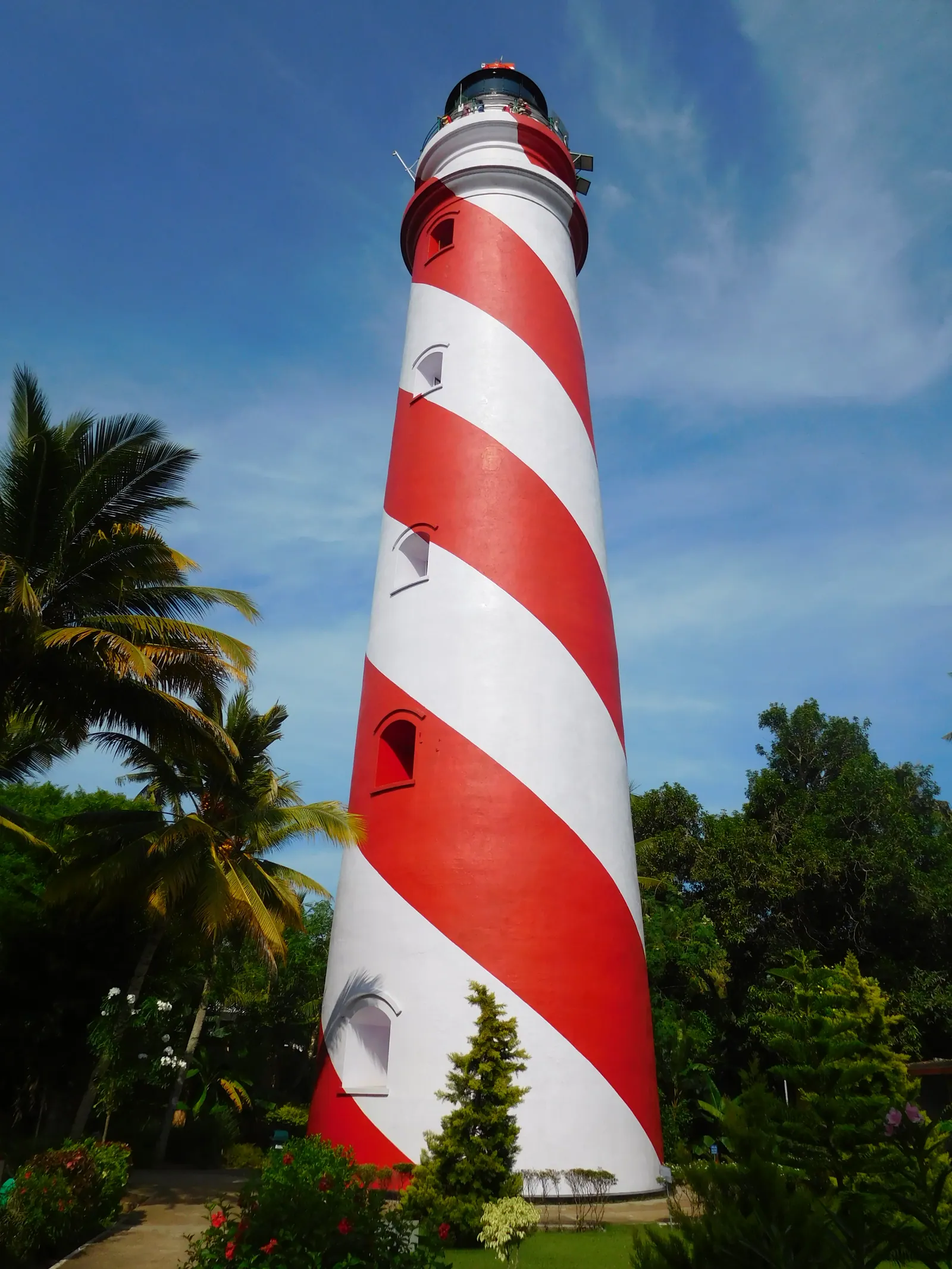
Tangasseri was a European trading settlement before it was part of the modern town, and the area still has the remains of a small fort, a church and a cemetery. The lighthouse is the landmark: a tall banded tower on the coast, visible from much of the seafront. The surrounding lanes are quiet, with Portuguese-era names and a mixed Christian and Muslim population.
The lighthouse is an active navigational aid, not a monument. Access and opening times depend on the authorities, and the viewpoint is not always open. Even if you cannot climb it, the walk along the shore is worth the detour, particularly in the late afternoon when the light comes off the water.
- Start at the port area and walk north rather than trying to drive between sights.
- Wear shoes; the lanes are uneven and the waterfront is wet in places.
- Ask before photographing people at work.
- Carry water; there are few cafes in the old streets.
The beach, and the truth about it
Kollam's beach is long and open, but it is not a resort beach. There are fishing boats, nets and debris, and the current can be strong. It is a place to walk and watch the light, not necessarily to swim. If you want a safer swim, head south towards Thirumullavaram or further to Varkala, and check local conditions.
This is also a good town for food. The fish is fresh, the breakfast places are cheap and the tea is strong. Try a local breakfast of puttu and kadala, or appam with stew, before the day heats up. The town's Muslim and Christian communities have left their mark on the food as much as on the architecture.
Sources & notes
- Kerala Tourism — official state tourism portal · checked 2026-10-22
- Wikipedia — place and history reference · checked 2026-10-22
Last updated 24 October 2026. Prices, opening hours and transport should be confirmed with official sources before travel.
Hello Kerala Publisher
Hello Kerala's editorial desk.
Found an error or an outdated detail?
Tell us