Waterfalls
Athirappilly: seeing the falls without the crowd
The Chalakudy river drops off the edge of the Ghats here, and the viewing is better than the car park suggests. A guide to timing, access and the forest that surrounds it.
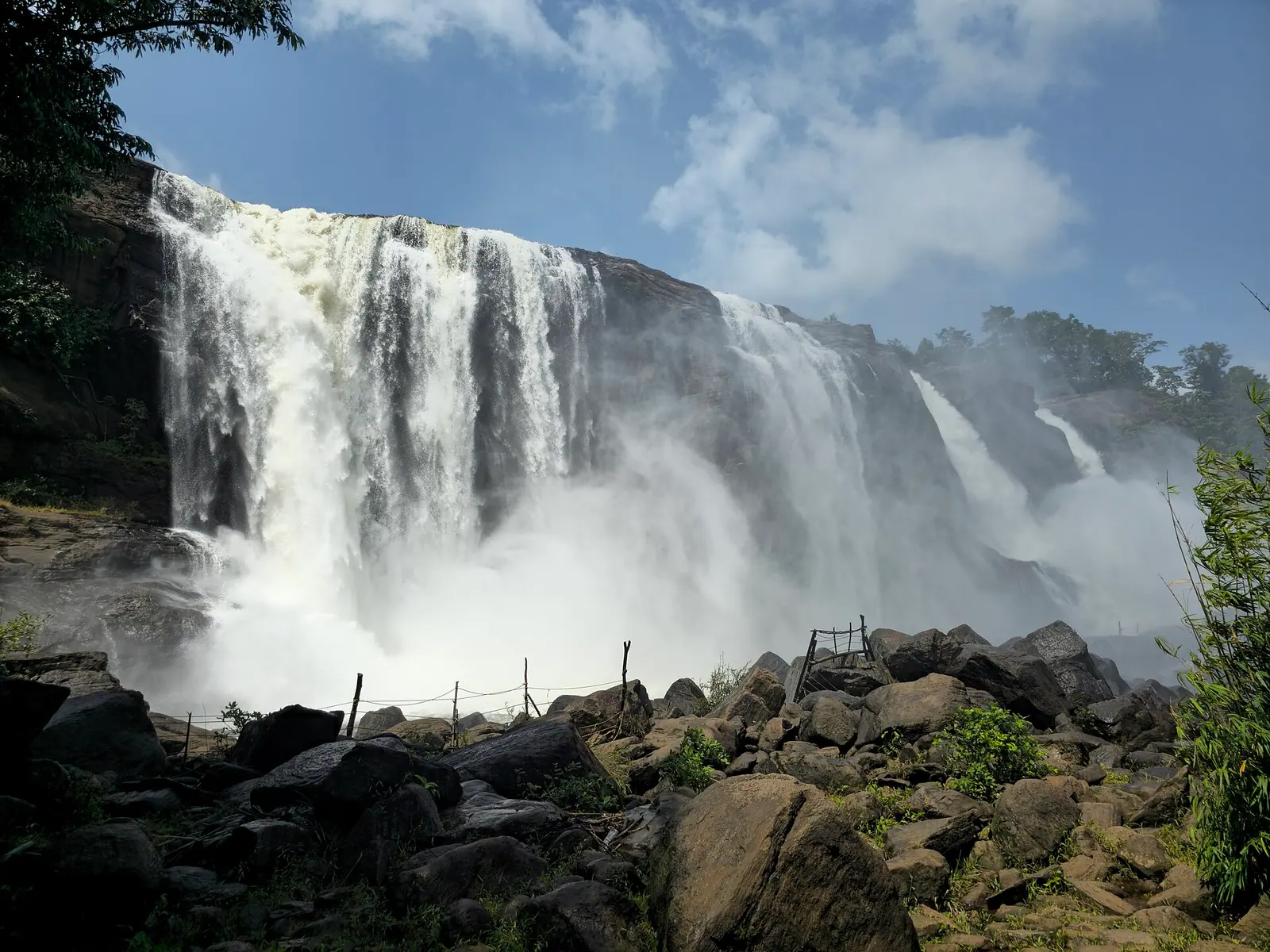
Athirappilly is the most photographed waterfall in Kerala, and for once the reputation is deserved. The Chalakudy river arrives across a broad, dark rock shelf and then simply disappears over the edge, throwing up a permanent haze of spray. The surrounding forest is thick, the air is cooler than the plains, and the whole scene has the slightly overwhelming quality of water doing something very large in front of you.
What the postcards do not show is the infrastructure around it: the car park, the ticket counter, the snack stalls and the concrete paths that keep visitors off the most fragile ground. That is not a complaint. A waterfall this popular needs managing. But it does mean the experience depends heavily on when you arrive and how far you are willing to walk.
The river and the drop
The falls sit on the Chalakudy, a river that rises in the Anamalai hills and runs west towards the coastal plain. At Athirappilly the land falls away in a single dramatic step, usually quoted at around 25 metres. The width matters as much as the height: this is a curtain rather than a ribbon, which is why it reads so clearly from a distance and why the spray carries so far.
Below the main drop the river turns and continues through a gorge, with a second, smaller fall at Vazhachal a short drive upstream. The two are often visited together, and Vazhachal is the quieter of the pair. If you have a car and an hour to spare, see Athirappilly first and then let Vazhachal slow you down.
Two ways to see it
The standard visit is from the forest park on the near side, where a path leads to a fenced viewing area facing the drop. It is the easiest option and the one most tour groups use. The view is good, the ground is manageable, and you do not need to be particularly fit. In busy periods the viewing area can feel like a queue with a waterfall behind it.
The other option is the longer path down towards the river, which gives a different angle and a sense of scale that the top view cannot. It is also steeper, wetter and occasionally closed. Do not assume it is open, and do not attempt it in sandals or with small children if the rock is slick. Ask at the counter which routes are available that day rather than following a guidebook from several years ago.
- Arrive early. The first hour after opening is cooler, quieter and better for photographs.
- Wear shoes with grip; the paths and viewing platforms stay wet from spray.
- Keep phones and cameras in something waterproof. The mist is not gentle.
- Treat the water as off-limits unless staff explicitly say otherwise. Rocks below the fall are smooth and the current is strong.
- Carry water and a light rain layer; the microclimate here is wetter than Thrissur town.
Monsoon power, dry-season calm
The character of the falls changes completely with the season. After the southwest monsoon the river is full and the fall is a roaring, opaque wall of water, often with restricted access because of the volume. In the drier months the flow narrows into separate channels, the rock shelf becomes visible and the pool below turns a clearer green. Neither version is the real one; they are two different places with the same name.
Monsoon visits need more caution, not less. Paths can be closed, the spray reaches further than you expect, and the combination of wet rock and a strong current is genuinely dangerous. If the forest department has closed a section, that is not an inconvenience to negotiate. It is the reason the place is still worth visiting.
The forest beyond the falls
The falls are part of the Vazhachal forest division, and the surrounding hills hold a mix of evergreen and deciduous forest with hornbills, elephants and the usual shy creatures that prefer not to be seen. This is not a safari. You are unlikely to tick off large animals from the viewing platform, and the forest is at its most rewarding on the quiet walk between the car park and the water.
Because this is a protected area, rules about plastic, alcohol, drones and loud music are enforced with varying enthusiasm but they do apply. Carry your rubbish out, keep speakers off and give other visitors room at the rail. A place this easy to reach absorbs a lot of people; small courtesies are what keep it tolerable.
Sources & notes
- Kerala Tourism — official state tourism portal · checked 2026-10-22
- Wikipedia — place and history reference · checked 2026-10-22
- Kerala Forest Department — protected areas, permits and ecotourism · checked 2026-10-22
Last updated 24 October 2026. Prices, opening hours and transport should be confirmed with official sources before travel.
Hello Kerala Publisher
Hello Kerala's editorial desk.
Found an error or an outdated detail?
Tell us